The truth about weaponizing the metamodel
Some people doubt that the Meta Model is normative. They are mistaken, because without a normative Meta Model, there are no NLP strategies, and without NLP strategies, there is no NLP. These people fear that calling people out on Meta Model violations means weaponizing the Meta Model. This fear is also unfounded.
To begin with, there is such a thing as a Meta Model monster. These are people who jump on every Meta Model violation, immediately telling you that the Meta Model does not allow you to say things that way. That is nonsense. First, because Meta Model violations are only a problem when they are relevant and significant. A violation of one of the twelve rules of the Meta Model is only significant and relevant when it prevents someone from achieving their goal.
Achieving your goals is important in NLP. Thanks to the TOTE model, NLP is entirely cybernetic in nature: the TOTE model is one of the most important cybernetic models, and every NLP strategy is a TOTE model. Within NLP, everything we do is ultimately translated into an NLP strategy. So, without the TOTE model, there are no NLP strategies, and without NLP strategies, there is no NLP. In short, NLP is 100% cybernetic.
Within cybernetics, everything is translated into goals and strategies for achieving those goals. Someone who consistently achieves their goals is considered healthy, while someone who consistently fails to achieve their goals is considered unhealthy. When language, whether in the form of thoughts or statements, prevents someone from consistently achieving their goals, it is extremely likely that the rules of the Meta Model are being violated. Helping someone rephrase their thoughts or statements then increases the likelihood of resolving their problems.
Take tinnitus, for example. Almost everyone who suffers from tinnitus thinks and says that it is always there. That is not the case. During dreamless sleep, for example, someone is not troubled by tinnitus. For that reason, it is better to say: “The tinnitus is only there when I pay attention to it.” Both descriptions describe the same reality. There is no difference whatsoever in the underlying reality. As far as reality is concerned, it therefore makes no difference which description you use. But thinking that the tinnitus is always there makes the problem bigger and keeps it in place. Thinking that the tinnitus is only there when you pay attention to it takes a first step towards a possible solution: to stop paying attention to it.
So never bother ordinary people with the Meta Model—but do hold NLP trainers to it!
If there is no relevant and significant reason to correct someone’s language, leave it alone. Moreover, when there is a reason, we have subtle ways of doing so, such as asking well-chosen questions. If NLP practitioners come across as people who can only communicate in jargon, they have been taught NLP poorly. After completing an NLP course, you are supposed to still come across as someone who can communicate normally.
NLP trainers are the exception. Jargon can be useful for communicating more efficiently with fellow professionals. NLP trainers should be able to manage their emotions well enough that there is no need to be subtle when communicating with them. NLP trainers should be able to take some criticism.
Furthermore, the Meta Model has an even more important function: communicating to clarify. When you follow the twelve rules of the Meta Model where they are significant and relevant, your communication is clarifying. If you consciously and deliberately violate those twelve rules, you are communicating to influence. If you accidentally and unconsciously violate the twelve rules of the Meta Model in a relevant and significant way, you are simply confused.
According to Richard Bandler, the creator of NLP, becoming an NLP trainer requires two things:
- You are good at doing NLP.
- You understand NLP.
Only when you can both do NLP well and understand NLP are you able to teach it to other people. A substantial part of your task as an NLP trainer is to clarify how NLP works and how it fits together. This means that you must be able to describe everything at the core of NLP—that is, all its core techniques, models, and strategies—without relevant and significant violations of the rules of the Meta Model. An NLP trainer who fails to do this is not an NLP trainer but a charlatan.
It is important to recognise that this requirement applies only to the core of NLP. NLP can be extended to encompass all human behaviour on earth, and it would be unreasonable to demand that an NLP trainer be able to explain all of it without violating the Meta Model. What matters here are the core components of NLP that enable you to map human behaviour, acquire it yourself, and pass it on to others.
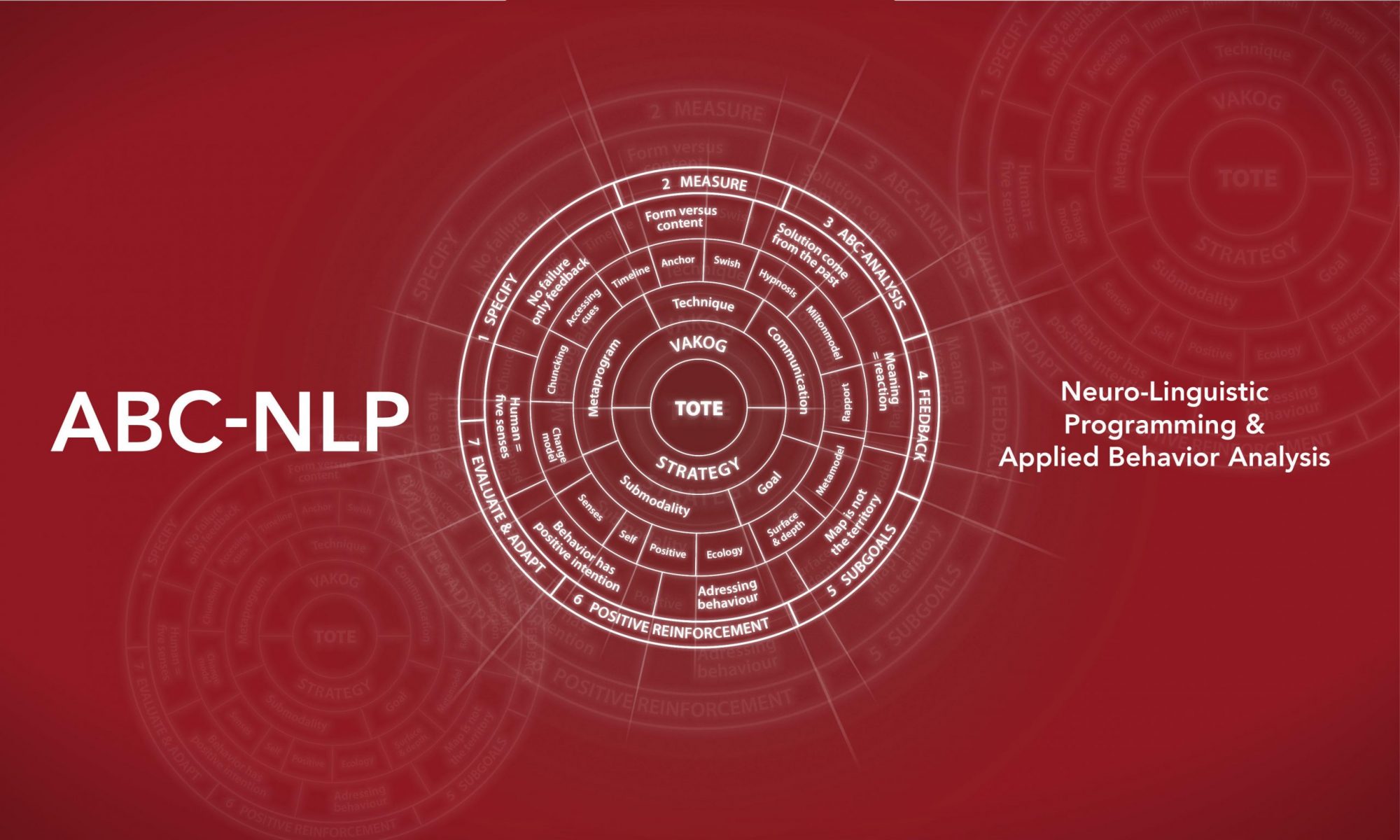
These are the following components, arranged by level:
- Foundational level #1: the TOTE model
- Level #2: NLP strategies
- Level #2: VAKOG modalities
- Level #3: Submodalities
- The NLP model of change
- Accessing cues
- Form versus content
- Level #3: Metaprograms
- Level #3: Goals
- Stated positively
- Behaviour has a positive intention
- Within your own control
- There is no failure, only feedback
- Formulated in terms of the five senses
- Everything human can be meaningfully expressed in terms of the five senses
- Ecologically sound
- We address behaviour, never the person
- Stated positively
- Level #3: Communication
- The Meta Model
- The map is not the territory
- The Milton Model
- Meaning is the reaction
- Surface structure and deep structure
- Chunking
- The Meta Model
- Level #3: NLP techniques
- Hypnosis
- Rapport
- Timeline
- Solutions come from the past
- Anchoring
- The Swish technique
- Level #3: Submodalities
If an NLP trainer fails to explain the topics on this list without making relevant and significant violations, that trainer has been poorly trained and is also training others poorly.