The truth about NLP and science

NLP has a difficult relationship with science. Although NLP was born at the University of California, Santa Cruz, there is no scientific evidence for NLP. Scientific research has been conducted into components of NLP. Sometimes it appears that there is some evidence for a particular component, but as a rule, this research is poorly conducted and published in lower-quality scientific journals. Better research published in better scientific journals shows that some components of NLP are questionable, particularly Eye Accessing Cues.
But no scientific research has been conducted into NLP as a whole. This is also impossible because there is no scientific theory for NLP. Without a scientific theory, you cannot formulate hypotheses and subsequently investigate them scientifically. For this reason, individual components of NLP that were suitable for scientific research have repeatedly been selected. In doing so, an important distinction has also been overlooked, namely the distinction between:
- NLP as a method for mapping human behaviour.
- The practical applications of NLP using behaviour that has been mapped.
Scientific research into Eye Accessing Cues investigates (a), while research into the Fast Phobia Cure investigates (b). These therefore concern two different things, yet in scientific research, they are lumped together under NLP.
The blame lies with NLP trainers
To be clear: scientists are not to blame for this. The blame lies with NLP trainers’ inability to formulate a coherent scientific theory for NLP. The truth is that what one NLP trainer teaches as NLP differs considerably from what another NLP trainer teaches as NLP. Moreover, most NLP trainers have themselves been poorly trained. The NLP Knowledge Test shows that NLP trainers themselves understand very little about NLP. Most NLP trainers score barely above what you would expect by chance on a multiple-choice test with four possible answers. Some NLP trainers score even lower than that. Most NLP trainers, however, are too afraid to take the test because they are very unsure of their own level of knowledge about NLP.
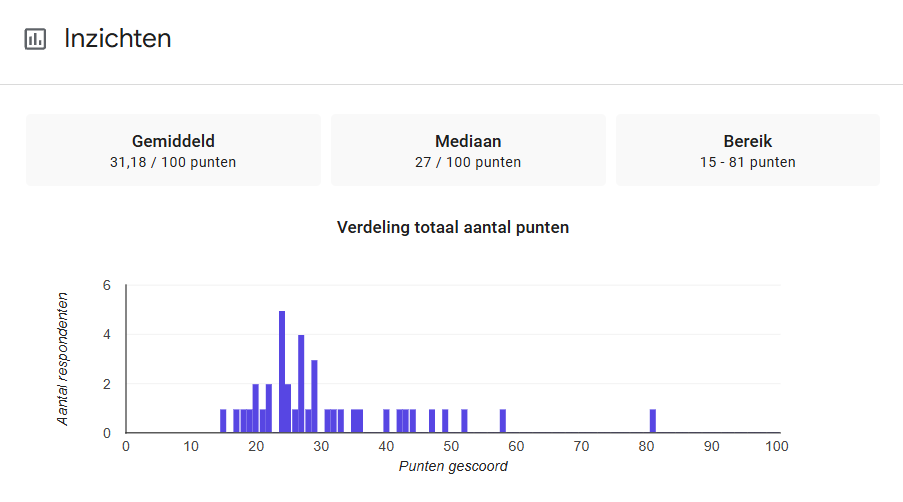 (Graph #1: on average, NLP trainers answer 32 out of 100 questions correctly.)
With NLP education this poor, it is naturally also impossible for scientists to investigate NLP properly. And that is a shame, because NLP is valuable enough to warrant rigorous scientific research.
A scientific theory for NLP
In the practical application of NLP (option b), hypnosis is primarily used. Hypnosis has been extremely well researched scientifically, and it has been scientifically proven that hypnosis works. The fact that hypnosis has been scientifically proven does not yet prove that NLP also works. At the same time, because NLP primarily uses hypnosis in its practical implementation, it is highly plausible that when NLP is subjected to rigorous scientific research, NLP will also turn out to work.
It is therefore a great shame that most NLP training programmes either do not teach hypnosis or teach a watered-down version of real hypnosis. That does not help in the slightest. The reason is that Richard Bandler hid hypnosis within NLP in the 1970s because he wanted psychotherapists to start using hypnosis, but the psychotherapists did not dare to do so. By hiding hypnosis within NLP, Richard Bandler succeeded in getting them to use NLP techniques that were hypnotic in nature.
However, there was such a proliferation of poorly trained NLP trainers in the 1980s that a substantial proportion of today’s NLP trainers have no idea that they are actually working with hypnosis. And if they use hypnosis at all, it is not real hypnosis, but a little Closed Eye Processing under the label of “trance work”. Yet there are rarely any hypnotic phenomena such as arm catalepsy, arm levitation, pain relief, deep trance identification, or resolving psychosomatic complaints through hypnosis. All of these are components that absolutely must be included in an NLP training programme for it to be a good training programme.
In 2016, Licensed NLP Master Trainer® Joost van der Leij was given the opportunity to teach NLP at a real university. However, this was only possible if he formulated a scientific theory for NLP. Combining NLP with Applied Behaviour Analysis, an established science since the 1950s, gave rise to ABC-NLP. ABC-NLP provides a basis for conducting rigorous scientific research into NLP. Until that happens, ABC-NLP is already being investigated by non-scientists, and there is also participation in the Interventions and Affect programme.